



Quad Fold Brochure Printing in Dubai
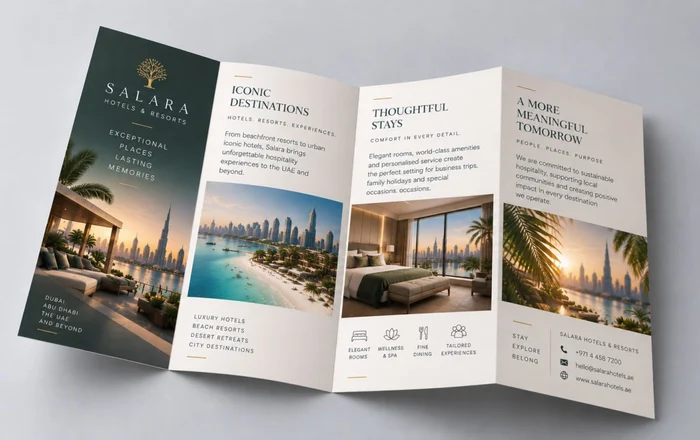
- Material: offset, coated, and designer paper.
- Format: A3, A4, A5, and custom sizes.
- Design: refinement or development of a unique layout.
- Printing methods: offset, digital, UV printing.
- Post-printing processing: embossing, folding, binding, laminating, die-cutting, corner rounding, perforation.
- Production time: from 1 day.
 Price list
A price list implies the use of a limited set of materials and production types.
Printing is a complex technological process where each order is unique and one-of-a-kind, and the cost depends on a number of factors, such as product type, size, material, finishing, print run, etc.
In a world of templates and ready-made solutions, we approach each customer individually, focusing on their specific “pain points”, and we take on the challenge of solving complex and unclear tasks. Relying on years of experience, the professionalism of our staff, and a constantly updated fleet of equipment, we can offer more options than just a dry cost in a table.
We will help optimise production, smooth out budget constraints, and find alternative solutions. Most importantly, everything is resolved through dialogue, where we ask clarifying questions to find the most convenient and most useful option.
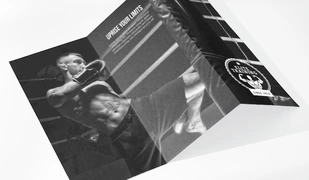
Quad fold brochures are used when a business needs to present a large volume of information but cannot increase the physical format of the material. In Dubai, this type of layout is applied in situations where space is limited, yet content must remain structured and readable.
PMG produces quad fold brochure formats for companies across the UAE that require extended internal space without changing external dimensions. This allows complex content to be distributed across multiple sections while keeping the document compact and practical for handling. Request a quote or contact our team to define the optimal structure for your brochure.
Where this format is used in business
Quad fold layouts are selected when content exceeds the capacity of simpler formats but still needs to remain organised. They are typically used for:
- product ranges with multiple categories
- service breakdowns with separate components
- corporate materials with layered information
- technical or explanatory documents
- marketing materials with extended structure
In these cases, the goal is not just to add space, but to control how information is divided.
How we print


Portfolio

Why companies choose quad fold brochures
The decision is based on balancing content volume and usability. This format is used when:
- reducing content is not an option
- increasing sheet size is not practical
- information must be separated into distinct sections
- the layout needs to remain compact for distribution
It provides additional internal capacity without affecting how the brochure is handled.
How the structure changes information flow
Unlike linear formats, quad fold brochures work as a segmented system. They:
- divide content into multiple independent sections
- allow the reader to focus on specific parts
- reduce visual overload within each panel
- maintain overall organisation despite volume
This makes them suitable for materials that are not read strictly in sequence.
Benefits


Content planning for multi-panel layouts
With more sections available, structure becomes a key factor. Effective use requires:
- assigning a clear purpose to each panel
- avoiding duplication of information
- maintaining logical grouping
- balancing text and visual elements
The objective is to simplify perception, not just expand space.
Production logic and technical factors
Quad fold production requires accurate alignment across all fold lines. Important parameters include:
- panel configuration and proportions
- fold-positioning accuracy
- colour consistency across sections
- material response during folding order volume
Because multiple folds are required, precision directly affects the final appearance.
Steps printing


Reviews
Our clients
























Timing, pricing and execution
Production time and cost are determined by layout complexity and technical requirements. They depend on:
- overall format and size
- material selection
- quantity
- finishing requirements
Each order is calculated individually based on how the brochure will be used.
Artwork preparation and layout control
File preparation must reflect the complete panel structure before production begins. Key considerations include:
- accurate panel mapping
- alignment across fold lines
- consistent margins
- CMYK colour settings
- appropriate resolution
Since the layout is divided into multiple sections, positioning accuracy is critical for proper assembly. All orders are checked against approved files before release.
Cooperation


