



One-Page Product Brochure Printing
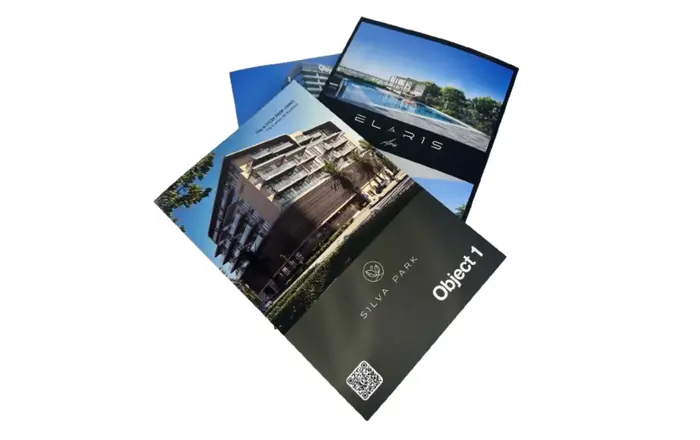
- Material: offset, coated, and designer paper.
- Format: A3, A4, A5, and custom sizes.
- Design: refinement or development of a unique layout.
- Printing methods: offset, digital, UV printing.
- Post-printing processing: embossing, folding, binding, laminating, die-cutting, corner rounding, perforation.
- Production time: from 1 day.
 Price list
A price list implies the use of a limited set of materials and production types.
Printing is a complex technological process where each order is unique and one-of-a-kind, and the cost depends on a number of factors, such as product type, size, material, finishing, print run, etc.
In a world of templates and ready-made solutions, we approach each customer individually, focusing on their specific “pain points”, and we take on the challenge of solving complex and unclear tasks. Relying on years of experience, the professionalism of our staff, and a constantly updated fleet of equipment, we can offer more options than just a dry cost in a table.
We will help optimise production, smooth out budget constraints, and find alternative solutions. Most importantly, everything is resolved through dialogue, where we ask clarifying questions to find the most convenient and most useful option.
In many commercial contexts, the value of printed material is determined by how quickly it communicates. A one page product brochure is used when there is no time for interpretation — the reader must grasp the offer instantly, without opening, unfolding or navigating complex layouts.
PMG produces single-sheet brochure formats in Dubai for companies that rely on direct, immediate communication during meetings, presentations and distribution. Designed to convey a complete message within a single visual field, this format enables decisions to be made without further explanation.
Request a quote or contact us to identify the most effective format for your material.
How we print


Portfolio

Where is used in business
A single-page brochure is typically chosen in environments where interaction time is limited and attention spans are fragmented.
It is commonly used for:
- product sheets handed directly to clients;
- sales materials distributed during meetings;
- promotional distribution at events;
- inserts included in packaging or documentation;
- quick-reference materials for internal use;
In these scenarios, the document serves as an immediate carrier of information − not a sequential presentation.
Why companies choose a one page format
The decision to use a one-sided brochure is typically driven by practical constraints, not design preference.
This format is selected when:
- information must be understood without explanation;
- the reader will not invest time navigating multiple sections;
- distribution volume is high, and simplicity is essential;
- the layout must remain visually controlled and predictable.
Unlike folded formats, there is no dependency on reading order. The entire message is visible at a glance.
Benefits


How layout affects performance
Since the format has no structural divisions, effectiveness depends entirely on composition.
A successful layout typically requires:
- clear hierarchy between primary and secondary information;
- controlled density of text and graphics;
- visual entry points that guide attention naturally;
- balanced spacing to avoid overload.
In this format, layout is not decorative — it directly determines how information is received.
Content strategy for single-sheet materials
A one page brochure permits no expansion -it requires selection.
In practice, this means:
- prioritising only essential information;
- removing secondary details;
- grouping content into distinct visual blocks;
- aligning messaging with visual emphasis.
This constraint often leads to clearer communication than larger formats.
Steps printing


Reviews
Our clients
























Production logic and cost factors
Although the format is structurally simple, production is still governed by technical parameters.
Key variables include:
- sheet size;
- paper type and weight;
- colour coverage;
- surface finishing;
- quantity.
Without folding stages, production flow is more direct, which can reduce processing time—particularly at higher volumes.
Technical preparation and output accuracy
Since the layout exists on a single surface, any imbalance becomes immediately apparent.
For this reason, file preparation must account for:
- exact proportions and margins;
- consistent colour setup in CMYK;
- correct scaling of graphic elements;
- sufficient resolution for print output.
Material selection affects both visual perception and tactile handling. Paper characteristics are chosen based on whether the brochure is intended for distribution, presentation, or internal use.
Each order is verified against the approved layout before release to ensure consistency.
Cooperation


FAQ
It is more effective when information must be understood instantly without navigating multiple sections or panels.
Yes, it is commonly used as a product sheet where key details are presented within a single layout.
Cost depends on size, paper selection, colour coverage, finishing and quantity.
Yes, it is often used for high-volume distribution due to its simplicity and ease of handling.
Files should be provided in print-ready format with CMYK colour mode, correct proportions and sufficient resolution.


