What Is UV Printing and When Does It Make Sense for Business Projects?
Many business owners first encounter UV printing when they want something that stands out from standard printed materials. A marketing team may be preparing premium brochures for a product launch. A luxury retailer may be developing branded packaging. An event organiser may need signage that remains vibrant under strong lighting conditions.
In all of these situations, UV printing is often recommended. Yet many decision-makers are unsure whether it is simply a premium finish, a different printing technology, or an investment that delivers measurable business value.
The answer depends on the project.
UV printing is not automatically the right choice for every job. However, in the right circumstances, it can improve durability, visual impact and production efficiency in ways that conventional printing methods cannot.
Why UV Printing Has Become Increasingly Popular
Commercial printing has changed significantly over the past decade. Businesses today expect more than accurate colour reproduction. They want materials that attract attention, reinforce brand quality and perform well in demanding environments.
UV printing addresses several of these requirements simultaneously.
Unlike conventional inks that dry through absorption or evaporation, UV inks cure instantly when exposed to ultraviolet light. This process creates a durable printed surface and allows printing on a wider range of materials.
For businesses, the results are often more important than the technology itself:
- sharper details
- vibrant colours
- reduced drying times
- improved resistance to scratches and moisture
- greater flexibility in material selection
These advantages explain why UV printing is now frequently used in packaging, retail displays, corporate branding materials and premium marketing campaigns.
How UV Printing Works in Practice
From a client's perspective, UV printing may look similar to other digital printing methods. The difference happens during production.
Special UV inks are applied to the surface and immediately exposed to ultraviolet lamps. Instead of soaking into the material, the ink hardens almost instantly.
This seemingly simple difference creates several practical benefits.
For example, when printing on coated stock, synthetic materials or certain packaging substrates, traditional inks may require additional drying time. UV printing significantly reduces this delay.
At PMG Printhouse, projects with tight production schedules often benefit from UV technology, as finishing processes can begin much sooner after printing.
For businesses preparing exhibition materials or event graphics under strict deadlines, this can make a meaningful difference.
What Makes UV Printing Different from Conventional Printing?
One common misconception is that UV printing simply produces brighter colours.
Colour quality is certainly one benefit, but the differences go much deeper.
Traditional printing methods often depend on the characteristics of the paper itself. Ink absorption affects sharpness, colour density and drying speed.
UV printing creates a cured layer on the surface rather than relying heavily on absorption.
This approach can deliver:
Greater Detail Reproduction
Small text, fine graphic elements and intricate design details often appear sharper.
This is particularly valuable for luxury packaging, cosmetic products and premium brand collateral where precision matters.
Improved Durability
Marketing materials are not always handled gently.
Brochures may be passed between multiple stakeholders. Packaging may travel through distribution networks. Retail displays may remain in place for weeks or months.
UV-cured inks generally offer better resistance to wear than many conventional alternatives.
Expanded Material Options
One of the most significant advantages is flexibility.
UV printing can be used on materials that are difficult to print using traditional techniques, including:
- plastics
- acrylic
- rigid boards
- certain synthetic substrates
- specialty packaging materials
For creative campaigns, this opens opportunities that would otherwise require more complex production methods.
Where Businesses Commonly Use UV Printing
The best way to understand UV printing is to look at real business applications.
Premium Packaging
Packaging often creates the first physical interaction between a customer and a brand.
For premium products, packaging quality directly influences perceived value.
UV printing allows brands to achieve:
- high-definition graphics
- rich colour saturation
- premium finishes
- durable surface performance
This is one reason why luxury retail, cosmetics and high-end consumer goods frequently incorporate UV printing into packaging production.
Corporate Marketing Materials
Business presentations, company profiles and product catalogues often require significant investments.
A catalogue distributed at a major exhibition may influence purchasing decisions long after the event itself.
UV printing helps preserve visual quality while creating a more professional appearance.
Retail and Exhibition Graphics
Dubai hosts hundreds of exhibitions and trade events every year.
Exhibition graphics face unique challenges:
- strong lighting
- heavy foot traffic
- frequent handling
- transportation between venues
Durability becomes just as important as appearance.
UV printing provides a practical solution for many of these requirements.
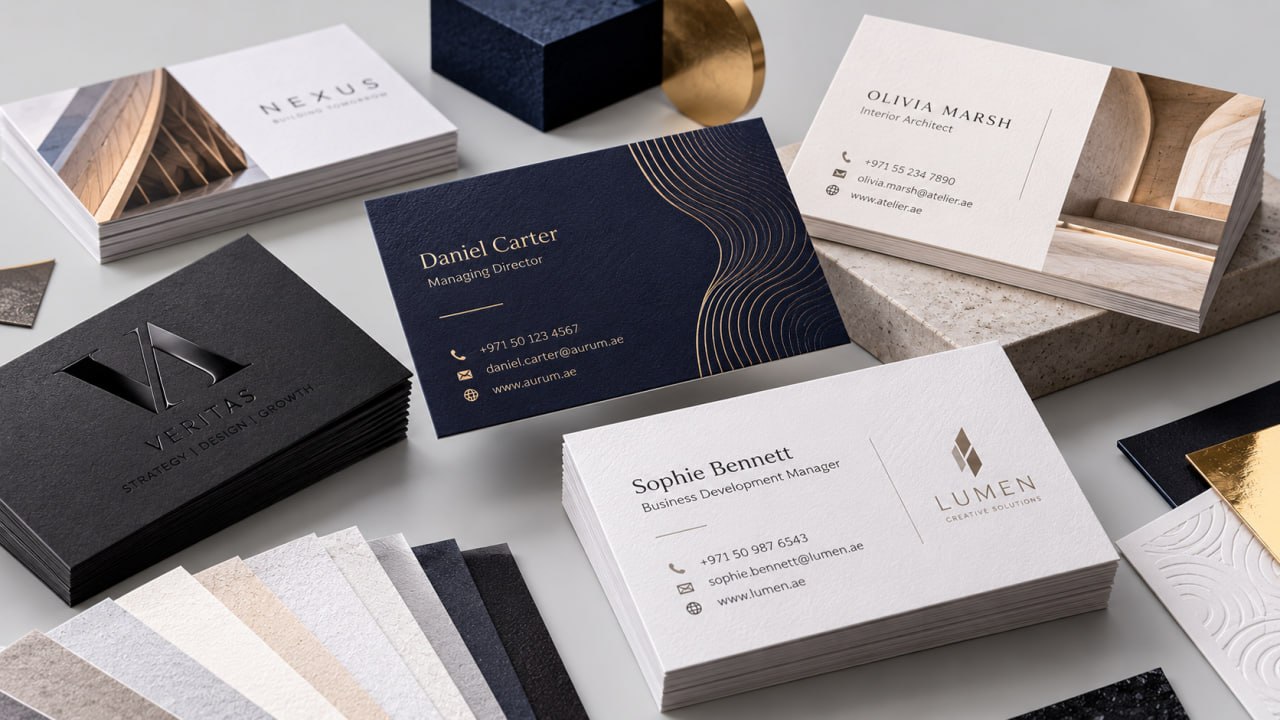
Premium Business Cards
Although digital communication dominates modern business, high-quality business cards continue to play an important role in networking.
When combined with specialty finishes, UV printing can help create memorable first impressions without requiring elaborate design changes.
When UV Printing May Not Be the Best Choice
One of the biggest mistakes businesses make is assuming that premium technologies automatically improve every project.
In reality, UV printing should be selected for specific reasons.
For very large-volume projects where durability is not a priority, alternative printing methods may provide better cost efficiency.
Similarly, if the chosen substrate performs perfectly with conventional printing, UV technology may not deliver sufficient additional value to justify the investment.
The most effective approach is to evaluate the following:
- project goals
- intended usage
- required lifespan
- budget
- material selection
before deciding on the production method.
Common Mistakes Businesses Make When Ordering UV Printed Materials
UV printing delivers impressive results when used correctly. However, even well-planned projects can fall short if important production considerations are overlooked.
One of the most common mistakes is to focus entirely on the printing method while ignoring the material itself.
A company may invest in UV printing for packaging, for example, but select a substrate that does not support the desired visual effect. In this situation, the technology is not the problem — the material choice is.
Another frequent issue is assuming that every design automatically benefits from UV printing.
In reality, UV technology tends to be most effective when it supports a specific objective:
- increasing durability
- enhancing colour vibrancy
- printing on non-porous materials
- creating premium visual presentation
If none of these objectives are relevant, other production methods may offer a better return on investment.
There is also a tendency to underestimate the importance of file preparation.
High-resolution artwork, properly defined colours and correctly supplied production files remain essential regardless of the printing technology being used.
UV printing can reproduce fine details extremely well, which means file imperfections often become more visible rather than less noticeable.
How to Decide Whether UV Printing Is Right for Your Project
For many businesses, the question is not whether UV printing is superior to other technologies.
The real question is whether it is the most appropriate solution for a specific project.
A useful way to evaluate the decision is to consider four factors.
Visual Impact
How important is appearance?
If the printed piece is designed to attract attention, represent a premium brand or create a memorable customer experience, UV printing often delivers noticeable advantages.
Material Requirements
What material will be printed?
Paper is only one option.
Modern marketing campaigns frequently involve rigid displays, packaging materials, synthetic substrates and speciality surfaces.
UV printing performs particularly well when material flexibility is required.
Product Lifespan
How long must the printed item maintain its appearance?
Materials intended for long-term use often benefit from the durability of UV-cured inks.
This consideration is especially relevant for retail graphics, branded displays and frequently handled marketing materials.
Production Schedule
How quickly must the project be completed?
Because UV inks cure immediately, production workflows can often move faster compared with methods that require significant drying time.
When deadlines are tight, this advantage can become a major factor.
How PMG Printhouse Approaches UV Printing Projects
One lesson that experienced print professionals learn quickly is that successful projects rarely begin with a discussion about technology.
They begin with a discussion about business objectives.
A product launch may require packaging that reinforces a premium brand image.
An exhibition campaign may require graphics that remain visually impressive throughout several days of heavy visitor traffic.
A corporate presentation folder may need to communicate professionalism and attention to detail.
The printing method is selected only after these objectives are understood.
At PMG Printhouse, UV printing is viewed as one tool within a broader production strategy, rather than as a universal solution. The goal is always to match the production method to the intended outcome.
In some projects, UV printing delivers significant advantages. In others, alternative methods may be more appropriate.
Making that distinction is often what separates an effective print investment from an unnecessary production expense.
Key Takeaways
- UV printing uses specially formulated inks that cure instantly under ultraviolet light.
- The technology offers excellent colour vibrancy, sharp detail reproduction and strong durability.
- UV printing can be used on a wide range of materials, including plastics, synthetic substrates and speciality packaging materials.
- It is particularly valuable for premium packaging, retail graphics, exhibition materials and high-impact marketing collateral.
- UV printing is not automatically the best choice for every project; material selection, budget and project goals should always be considered.
- Proper file preparation remains critical to achieving professional results.
- The most successful print projects begin with business objectives rather than production technology.
Whether you are producing branded packaging, exhibition graphics, corporate marketing materials or premium printed collateral, UV printing can offer significant advantages when aligned with your project goals. The key is understanding not just what the technology does, but where it creates genuine value. By evaluating materials, durability requirements, visual expectations and production timelines together, businesses can make more informed printing decisions and achieve stronger results from their marketing investments.