Types of Embossing in Printing
The printing industry is constantly evolving, offering businesses increasingly sophisticated ways to present their products. Among the many techniques used to create images and patterns, embossing holds a special place. It is a production process that creates three-dimensional images on various surfaces through mechanical pressure. In printing, embossing falls into the category of post-press finishing, meaning that it is carried out after the main printing process. This technology transforms ordinary paper or card into a premium product that appeals not only visually but also to the sense of touch. The process involves pressing the material between two forms: a punch (die) and a counter-die. This creates a raised or recessed design on the surface. The method has been known for centuries, but modern technology has made it more accessible and versatile.
Benefits for Businesses
Using embossing in print production offers substantial benefits to businesses competing in the market.
Tactile Appeal
In an age dominated by touchscreens, people crave real, tactile experience. A raised element on a printed product invites people to touch it and hold their attention for longer. This increases the time people spend interacting with a promotional item, directly influencing brand recall. An embossed logo is perceived as a mark of quality and reliability.
Visual Impact
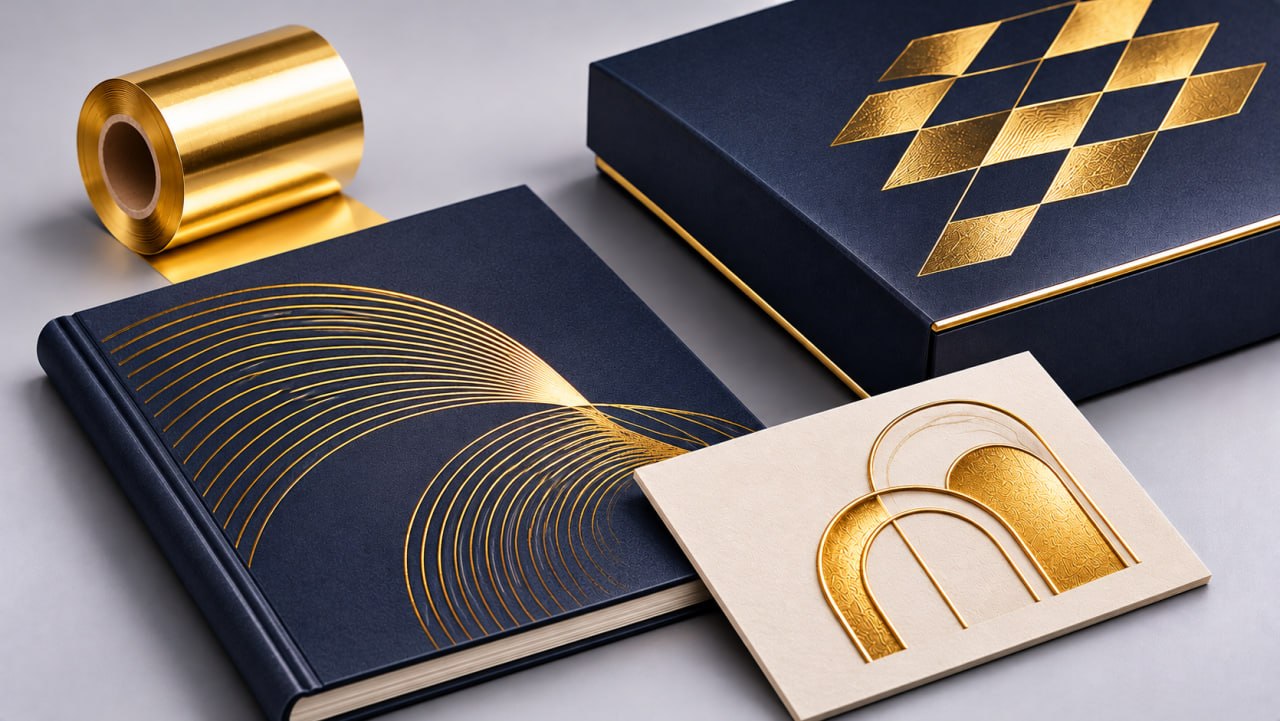
A raised design creates subtle shadows that change depending on the viewing angle. This adds dynamism to an otherwise static image. The effect is particularly striking when combined with foil. The shine of the metallic surface, combined with the raised detail, creates a wow factor. Printed products finished to this standard often become collector’s items or are simply kept for longer than ordinary printed materials.
Versatility
Embossing can be used at virtually any stage of production. It is suitable for adding designs to business cards, brochures, book covers, boxes, labels and even textiles. The technology can be adapted to different requirements. For example, cosmetic packaging needs to convey a sense of softness and luxury, which can be achieved with soft embossing. Technical documentation, by contrast, requires clarity and durability, which blind embossing provides. The printing industry offers solutions for every market niche.
Durability
Unlike printed ink, which can wear away over time, a relief created by this method remains permanently in the material. When foil stamping is used, the metallic layer can be protected with varnish or lamination, extending the life of the image. This is particularly important for items that see frequent use, such as restaurant menus, passes, identification cards and diary covers. The product retains its presentable appearance even after months of use.
Combining Embossing with Other Finishes
Embossing works well with UV varnishing, die-cutting and lamination. This gives designers much greater creative freedom. Print production becomes a space for experimentation, where every project can be unique. Creating raised images opens up new possibilities for branding.
Helping to Segment the Audience
Products with this type of finish are clearly positioned in the premium or business segment. This filters out customers who are unable or unwilling to pay for higher-quality products and attracts target customers who are prepared to pay for quality. The embossing method can signal a company's status. Using an expensive technique on an inexpensive medium may create a mismatch, so it is important to strike a balance. With the right approach, embossing can strongly influence customers’ perception of a product’s or service’s value.
Types of Embossing: Techniques and Features
Modern printing offers several main types of embossing, each with its own technical characteristics and applications. The choice of method depends on the purpose, budget and type of material.
Foil Stamping
Foil stamping is the most common and recognisable type of finishing. The process involves transferring a thin layer of metallic or pigmented foil onto the surface of a material using heat and pressure. Specialised equipment known as a foil stamping press is used for this purpose. The process requires a die made from magnesium, copper or brass. The die is heated and pressed against the foil and the paper or card beneath it. At the points of contact, the foil's adhesive layer is activated and bonds firmly to the substrate.
Foil stamping can be carried out using two main methods: hot and cold. Hot foil stamping is the traditional method. It involves heating the die to a specific temperature, usually between 100 and 150°C. This method provides strong adhesion between the foil and the material. It is ideal for large print runs and dense materials such as card or leather. Cold foiling is a more recent technique that does not involve heating the die. Instead of a heat-activated adhesive, a special UV-curable adhesive is applied to the material by printing. The foil is then pressed onto the adhesive and exposed to ultraviolet light.
Cold foiling has several advantages: it is faster and cheaper for large print runs because there is no need to allow time for heating and cooling. However, adhesion may be slightly weaker than with hot foil stamping, and the choice of foil is more limited.
Foil for stamping comes in various types. Metallic foil creates gold, silver, copper or bronze effects. Pigmented foil is available in every colour of the rainbow, including white and black. Holographic foil is often used to prevent counterfeiting. The choice of foil depends on the design concept.
Blind Embossing
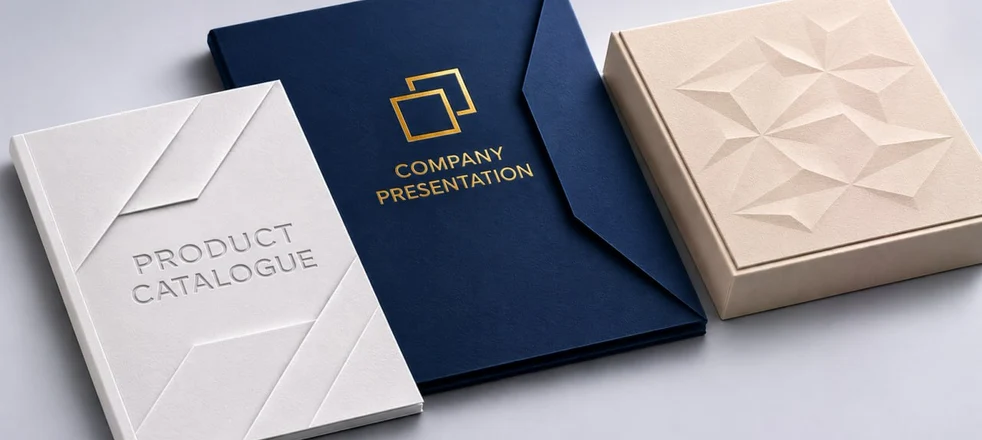
Blind embossing creates a relief effect without changing the colour of the surface. In this case, only pressure is used, with heat being optional. The die is pressed into the material, creating a recessed or raised design. Blind embossing is appreciated for its understated elegance. This technique is used on dense materials where the relief will be clearly visible. Thin paper may tear under pressure, so card weighing at least 250 gsm is better suited to blind embossing. Blind embossing is ideal for business cards, book covers and wedding invitations. It adds a tactile quality that cannot be achieved through conventional printing alone. The finished piece invites people to hold it in their hands and examine it from different angles.
Sculptured Embossing
This type creates a three-dimensional image using a pair of dies: a male die (the raised part) and a female die (the recessed part). The material is placed between them, and high pressure forms the relief. Unlike blind embossing, which often uses just one die, this technique requires precise alignment between the two sides. This produces deeper, more detailed relief. Embossing can create a raised image on the front and a recessed image on the reverse, or vice versa. The depth can range from fractions of a millimetre to several millimetres. Multi-level embossing produces complex 3D effects in which different elements of the design have different heights. This type of embossing is often combined with foil stamping. First, the foil is stamped onto the material, and then the same design is embossed along the same contours.
Materials used for embossing must be pliable and dense. Long-fibre designer papers, card and leather are suitable options. On fragile materials, embossing can cause the fibres to split along the edges of the relief. A test embossing should therefore always be carried out before the full print run begins.
Embossing is the choice for those looking to emphasise exclusivity.
Where and Why Is Embossing Used?
Embossing has a wide range of applications in the printing industry. The main uses include the following.
- Corporate print: business cards, document folders, letterheads and envelopes.
- Packaging and labels.
- Books and magazines: book and magazine covers are often decorated with embossing.
- Promotional merchandise and gifts: diaries, notebooks, pens and USB flash drives with leather or plastic casings are often decorated with embossed designs.
- Invitations: for weddings, corporate events and conferences.
- Documents: diplomas, certificates, shares and bonds are often protected against counterfeiting through embossing. Holographic foil or intricate raised designs make them more difficult to forge.
- Promotional materials: leaflets, brochures and catalogues may feature embossing to highlight key offers.
Technical Considerations and Material Selection
A successful embossing project requires careful consideration of the design, materials and dies. Smooth coated paper reproduces fine details well, but fingerprints can easily show up on its surface. Textured designer papers conceal minor imperfections but may not reproduce fine lines clearly. Card must be sufficiently rigid to retain the shape of the relief.
Leather and imitation leather are excellent materials for embossing. They are pliable and retain the shape imparted by the die. However, the heating temperature must be carefully controlled to avoid scorching the material. Plastic and film can also be embossed, but they require special foil with high adhesion to polymer surfaces. Printing on synthetic materials is more complex than on paper, so testing is important before the full print run begins.
The tooling (die) plays a key role. Magnesium is inexpensive and quick to machine, but its service life is limited to a few thousand impressions. Copper is more expensive but lasts longer and produces sharper images. The most expensive and durable, brass is ideal for very large print runs and intricate three-dimensional designs. The choice of die material depends on the print run size and the complexity of the design.
Temperature and pressure are the two main machine settings. Each type of foil and paper has its own recommended settings. Excessive heat can cause the foil to lose its lustre or develop bubbles. If the temperature is too low, the foil may fail to transfer.
Pressure must be even across the entire surface of the die. Precise alignment is essential when embossing is applied over an existing printed image; otherwise, the foil may not line up correctly with the design. Modern equipment can align the foil with the design to within fractions of a millimetre. However, human error and the properties of the paper, including expansion during printing, can affect the result. The production process therefore requires continuous monitoring. For businesses, it is important to understand that embossing is not simply an expense but an investment in the brand. When used correctly, it can help a company stand out from hundreds of competitors.