Types of Calendars in Commercial Printing
Calendars are among the most popular and recognisable products in the printing industry. Despite advances in digital technology, printed calendars remain relevant, serving as practical planning tools and effective branding materials. The range of calendar types available in commercial printing is extensive, making it possible to find the right solution for almost any purpose, from personal use to large-scale advertising campaigns. Calendar products account for a significant share of the market because they combine practical functionality with marketing potential.
At a modern printing house, calendar production involves much more than simply printing dates on paper. It is about creating a practical product that customers use over an extended period. Most calendars feature a grid showing days, months and years, but their formats, layouts and designs can vary considerably. Choosing the right format and type of calendar is an important decision for any business placing an order.
What Are the Advantages of Printed Calendars?
Printed calendars offer several clear advantages over their digital counterparts. One of the main benefits is their constant visibility. An advertising calendar displayed in an office or at home keeps a company's brand in view throughout the year. Unlike a digital notification that can be dismissed and forgotten, a printed calendar remains visible, providing a regular reminder of the brand. Companies that commission these products are investing in long-term brand recognition.
Time is a valuable resource, and calendars help people manage it effectively. A printed calendar enables users to make handwritten notes, which many find more convenient than entering information on a smartphone. It also provides a clear visual overview of time, allowing users to see an entire month or year at a glance and plan their activities accordingly. The printing industry offers solutions designed to simplify this process. For example, space for notes alongside each date makes a calendar more functional. Calendars designed with ease of use in mind are practical tools for both everyday life and the workplace.
Another advantage is their tactile appeal. The feel of the paper, the quality of the printing and the sturdy construction of the calendar all help create a positive impression.
Calendars also become part of the interior. A wall calendar can complement a room's décor, while a desk calendar helps keep a workspace organised. This can enhance the perceived value of a brand. Unlike banner advertising, a calendar is not discarded immediately after use. It remains in use for at least a year and sometimes longer, particularly when the design is appealing. The industry responds by developing increasingly attractive calendar designs. Types of Calendars by
Where They Are Displayed
Calendars are most commonly classified according to where they are displayed. Each type has its own features and applications.
Wall Calendars
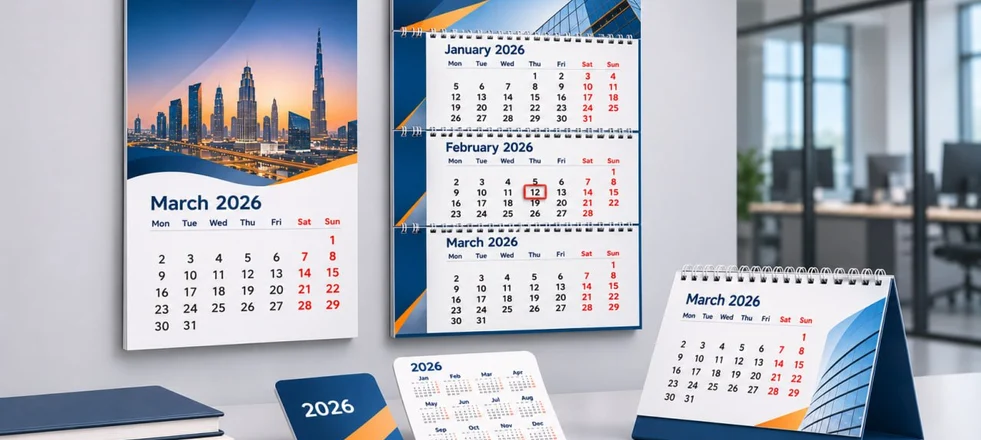
Wall calendars are among the most popular choices for offices and public spaces. Their large format makes them easy to read from a distance. One of the most common types is the wire-bound wall calendar, which features separate pages that are turned over each month. This format makes it easy to keep track of dates without taking up desk space. Poster-style calendars are another option, with the entire year displayed on a single sheet. A wall calendar needs secure mounting and good-quality paper to prevent it from becoming deformed over time. Customers can choose from various mounting options, including eyelets and magnetic strips. The design should be easy to read and complement the surrounding décor.
Desk Calendars
Desk calendars are designed for individual workspaces. The most common type is the tent calendar, which has a triangular shape and stands securely on a desk. Its format makes it easy to check the current date at a glance. With a flip desk calendar, users reveal a new month and hide the previous one. This saves space and keeps the information current. Desk calendars are generally smaller than wall calendars, but are made from heavier paper to help them keep their shape. They are also widely used as promotional gifts or marketing tools.
Pocket Calendars
Pocket calendars are compact products that are easy to carry. They are often similar in size to a business card or credit card and can be kept in a planner or card holder. Despite their small size, the calendar grid remains legible. Pocket calendars are often distributed in large quantities at events or included with purchases. They are an inexpensive yet effective promotional medium. Printing in this small format requires precision, as all the design elements are scaled down.
Types of Calendars by Time Period
The time period covered is another important factor in classifying calendars as it affects the calendar’s purpose and content.
- Quarterly calendars. These are standard in business. A quarterly calendar displays three months at a time, offering a good balance between detail and an overview of the schedule. Office staff often use this type of calendar to track deadlines and plan their schedules. The calendar grid is large enough for making notes, and the calendar is generally designed to be hung on a wall.
- Monthly calendars. These provide space for additional details, such as public holidays, lunar phases and important events. The design can be tailored to a different theme for each month. Monthly calendars are often printed for promotional purposes.
- Yearly calendars. These show the year's dates, public holidays and weekends in one place, making them useful for long-term planning. They are versatile products for managers and work planners.
Types of Calendars by Theme
A calendar's theme determines its visual style and content, making it relevant to a specific group of users.
- Corporate calendars. Designed specifically for a company, these calendars feature its corporate identity, logo and brand colours. They are often given to business partners and employees, serving as a tool for both internal and external communication. The design should reflect the organisation's image.
- Industrial calendars. These reflect shift patterns and operational schedules. They may include working days, days off, changes to public holiday dates and technical breaks. The calendar grid is organised around production cycles, with ease of use taking priority over decoration.
- School calendars. These follow the academic year rather than the calendar year, starting in September and ending in May or June. They are useful for pupils, students and teachers. Designs often incorporate educational content such as formulae, maps and rules. School calendars help users plan lessons, school holidays and examinations. They come in various sizes, from wall calendars to pocket-sized versions that fit in a school diary.
- Religious calendars. These contain information about religious holidays, fasting periods and saints' feast days. They are important to religious people. The design is usually restrained and incorporates religious symbolism. Religious calendars can be wall-mounted or pocket-sized for personal use, and feast days are often highlighted in colour.
A calendar is more than a collection of dates: it is a practical way to organise time and keep important information close at hand. Although technology will continue to evolve, the fundamental purpose of calendars will remain the same: to help people keep track of time. Our printing house meets a wide range of market demands with attractive, practical calendars for every occasion.