
Short-Run vs Long-Run Printing: What Should Businesses Choose?
The lowest price per printed piece is not always the lowest-cost option for a business. A quotation for 5,000 brochures may show a much lower unit price than a quotation for 1,000. That looks attractive until the business realises that the information in those brochures will change in three months. The additional 4,000 copies may then become stock that has been paid for but cannot be used.
The opposite can happen as well. A company may order only a few hundred copies at a time to avoid holding stock, but repeated small orders can increase production, delivery and administrative costs. The right print run is therefore not simply a choice between short-run and long-run printing. It depends on how quickly the material will be used, how long the artwork will remain relevant, how predictable demand is, how much stock can be stored and which printing process suits the specification.
The Quantity on the Quotation Is Only One Part of the Calculation
Print buyers naturally look at the price per copy because it makes different quantities easy to compare. A quotation might show a steadily decreasing unit price as the quantity increases:
- 500 copies — higher unit cost;
- 1,000 copies — lower;
- 2,500 copies — lower again;
- 5,000 copies — lower still.
But the unit price does not tell you which quantity the business should buy. If a company needs 800 brochures, ordering 5,000 because the unit price is lower does not automatically save money. The additional copies still have to be produced, delivered and stored, and they may eventually become obsolete. A more useful calculation considers the wider cost of the printed material:
production + finishing + delivery + storage + repeat orders + obsolete stock
This changes the question from “Which quantity has the lowest price per copy?” to “Which quantity gives us the right amount of usable material for the money we spend?” That distinction is central to choosing a print run.
When a Short Run Makes Sense
Short runs are particularly useful when flexibility has a financial value. This is often the case when demand is uncertain, a product is being launched for the first time, information changes frequently or the material is tied to a short campaign. A limited first run can allow a company to observe actual consumption before committing to a larger quantity. The next order can then be based on real demand rather than an estimate. This approach can be useful for:
- new products and services;
- seasonal offers;
- limited-time promotions;
- exhibitions and events;
- product launches;
- materials with frequently changing prices or specifications.
For example, a real estate company may need brochures for a development whose availability changes throughout the sales process. Producing a very large quantity at the beginning may leave the company with brochures that no longer reflect the properties, prices or terms being offered.
In such cases, the flexibility of a shorter run can be worth more than the lower unit price of a larger one.
When a Larger Run Becomes More Efficient
A larger print run becomes more attractive when demand is predictable and the artwork is expected to remain unchanged. If a company knows from previous experience that it consistently uses a particular quantity of brochures, folders, envelopes or packaging, it can plan production around actual consumption rather than an uncertain forecast.
This is where the economics of production become important. Some printing processes involve preparation and setup costs that do not increase in direct proportion to the number of finished copies. When a larger quantity is produced, those costs are distributed across more units, reducing the cost per piece.
The saving becomes meaningful when the business can actually use the additional stock. A company that regularly consumes 20,000 standard packaging units over a defined period has a very different production requirement from a business testing its first product and still trying to establish demand. The same principle applies to corporate stationery, standard brochures, catalogues and other materials with a long and stable period of use.
Bulk Printing Has Its Own Risks
The opposite mistake is to order too much simply because the unit price falls. Additional stock needs physical space, and this can be particularly significant for packaging, folders, boxes and other bulky printed products. Materials also need to be protected from moisture, dust and physical damage and stored somewhere they can be accessed efficiently.
More importantly, excess stock carries a risk of becoming commercially useless.
A large quantity of a stable corporate folder may be easy to justify. A large quantity of a seasonal insert, price list or product-specific package may be much harder to justify because its useful life is shorter.
The relevant question is therefore not simply whether the business has room to store the material, but whether the material is likely to remain useful for as long as it takes to consume the stock. Storage is only one part of the cost of holding a large print run.
A larger order also requires a larger payment at the beginning. The unit cost may be lower, but the business has to commit the full amount before all of the printed material is used. For a company with predictable demand and sufficient working capital, this may be straightforward. For a growing business managing several product launches, campaigns or packaging changes at the same time, tying up cash in unused stock may be less attractive. The print run therefore has both an inventory dimension and a cash-flow dimension. Before ordering a large quantity, it is worth considering:
- where the stock will be stored;
- how much space it will occupy;
- how quickly it will be consumed;
- how long the artwork is expected to remain valid;
- how much capital will be committed to the order.
Not Every Component Needs the Same Print Run
A business does not necessarily have to choose one production quantity for an entire project.
Stable and changeable elements can be separated. For example, a company might produce a larger quantity of:
- standard branded folders;
- corporate envelopes;
- stable packaging;
- long-term information sheets.
At the same time, it could produce smaller quantities of:
- seasonal inserts;
- promotional stickers;
- campaign-specific leaflets;
- materials with changing prices;
- event-specific information.
The same principle can work for packaging. A standard box can be produced in a larger quantity while seasonal sleeves, promotional labels or information inserts are produced separately in shorter runs. This allows the business to benefit from production efficiency where the specification is stable without creating unnecessary stock where information changes frequently.
How to Compare Different Print Quantities
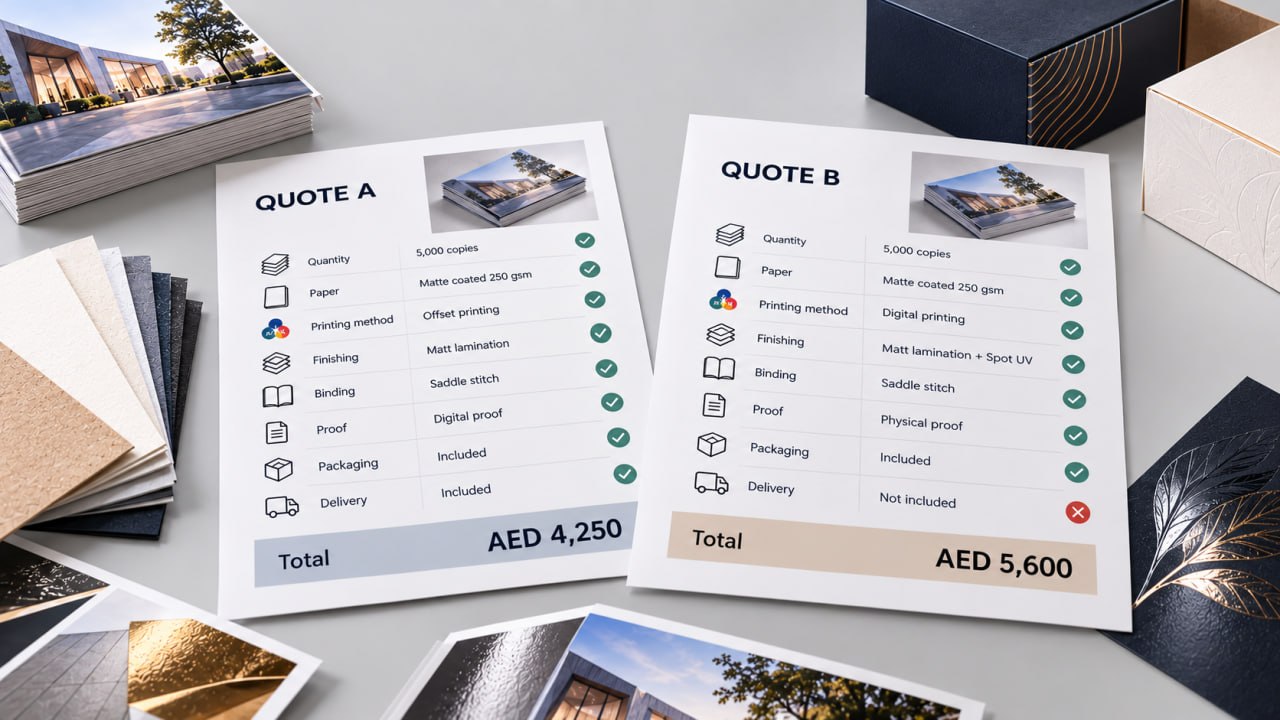
When requesting a quotation, it is often more useful to ask for several quantities rather than one. For example:
| Quantity | What to examine |
| 500 | Initial commitment and flexibility |
| 1,000 | Short-run economics |
| 2,500 | Change in total and unit cost |
| 5,000 | Larger-run economics |
The important figure is not simply the lowest unit price. Look at how much additional budget is required to move from one quantity to the next and whether the additional stock is likely to be used. If moving from 1,000 to 2,500 copies requires a relatively small additional investment and the business expects to use the material within its useful lifespan, the larger quantity may be practical.
If the additional copies are likely to remain in storage until the artwork changes, the lower unit price may provide little real benefit.
For repeat orders, previous consumption is usually a more useful starting point than an optimistic forecast. Actual usage over the previous months or years can reveal how quickly the material is really being consumed.
When a Hybrid Approach Works Better
The choice does not always have to be short run or long run. A business can combine different production strategies within the same programme. A stable brochure might be produced in a larger run, while a changing insert is printed separately in smaller quantities.
A retailer could produce a substantial quantity of standard packaging while keeping campaign-specific labels in shorter runs. A hospitality business could maintain a stock of branded folders and produce seasonal promotional material separately.
This approach separates the stable elements from those that change frequently. It can reduce the risk of obsolete stock without giving up the production efficiency available for materials with predictable demand.
Five Questions to Ask Before Choosing the Quantity
Before approving a print run, it is useful to answer five practical questions:
- How quickly will we use the printed material?
- How long will the current artwork remain valid?
- How easy and costly will it be to reorder?
- How much space and working capital will the stock require?
- Which printing process suits the complete specification?
The answers provide a more useful basis for the decision than unit price alone. A business with stable demand, long-lasting artwork and manageable storage has different requirements from one dealing with uncertain demand, frequent updates or short campaigns. The important point is to choose the quantity around the material's real life cycle rather than around the lowest number on a quotation.