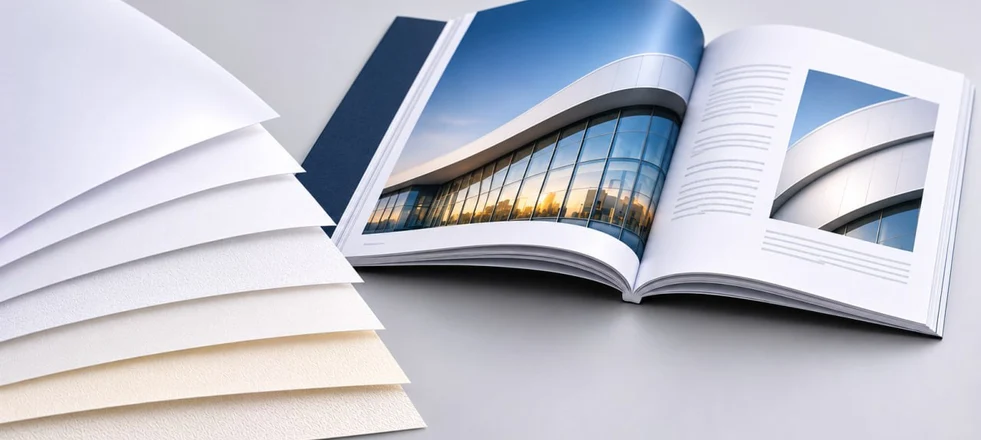
Paper Specifications: Grammage and Its Impact on the Printing Process
The physical properties of paper affect the appearance and performance of the finished print run. Grammage is a basic specification that affects stiffness, opacity and how ink behaves when applied. Choosing the right paper helps avoid production problems and ensures that the finished product meets its intended purpose.
Grammage is measured in grams per square metre (g/m²) and indicates the mass of one square metre of paper. It should not be confused with thickness, although the two are often related. To calculate grammage, you only need to know the weight of a standard ream of A4 office paper (500 sheets). One A4 sheet has an area of 1/16 of a square metre. A ream therefore contains 31.25 m² of paper. Dividing the stated weight of the ream (for example, 2,500 g) by 31.25 gives the grammage: 80 g/m².
Higher grammage generally provides greater stiffness and opacity. Opacity is important for double-sided printing: if text or graphics on the reverse side show through, the material becomes harder to read. Heavier paper can also feed more reliably through a printing press, reducing the risk of jams and helping maintain accurate registration.
Types of Paper and Their Uses
The choice of paper depends on the requirements of the printed product.
- Uncoated paper. This paper has no coating and absorbs ink readily. Its grammage ranges from 60 to 120 g/m². It is used for forms, draft brochures, book interiors and mass-market periodicals.
- Newsprint. Made from wood with minimal processing, newsprint has a low grammage (45–52 g/m²), high porosity and a greyish tint. It is used mainly for newspapers and inexpensive advertising materials.
- Coated paper. The surface has a coating that covers the pores in the paper and prevents ink from penetrating too deeply. Its grammage ranges from 90 to 300 g/m², and it is available in gloss and matt finishes. It is commonly used for catalogues, magazines, advertising brochures and packaging where accurate reproduction of halftone images is required.
- Design paper. This paper is made from cellulose pulp with added dyes, textured fibres or special coatings. Its grammage often exceeds 200 g/m². It is used for business cards, premium packaging, invitations and point-of-sale (POS) materials.
How Grammage Affects Print Quality
Grammage affects the physical and visual properties of the printed result.
- Colour reproduction. On porous paper with a low grammage, ink is absorbed quickly, which can reduce contrast and blur fine halftone dots. Coated paper holds the ink closer to the surface, producing sharper edges and more solid areas of colour.
- Durability. Products that are handled frequently, such as business cards, menus and price tags, often need a higher grammage to retain their shape and resist tearing at the folds.
- Brochure construction. The paper weight of the inner pages and cover must be balanced; otherwise, the brochure may become distorted or may not open easily.
Choosing Grammage for Different Applications
- Documents and drafts: 70–80 g/m². Uncoated paper for everyday printing and internal use.
- Informational materials: 100–130 g/m². Suitable for leaflets, flyers and multi-page brochures. It provides adequate stiffness without adding excessive weight to the finished product.
- Catalogues and magazines: 130–170 g/m² for the inner pages and 200–250 g/m² for the cover. A good balance for printed products featuring halftone images.
- Packaging, business cards and POS materials: 250–350 g/m². This paper can be creased and folded while retaining its shape during use.
Paper selection also depends on the capabilities of the printing equipment. Paper that is too thin can cause problems during lamination, while paper that is too heavy may not feed properly through a digital press. The print shop selects the appropriate paper based on the project requirements, taking into account the print run, printing method and intended use of the finished product.