
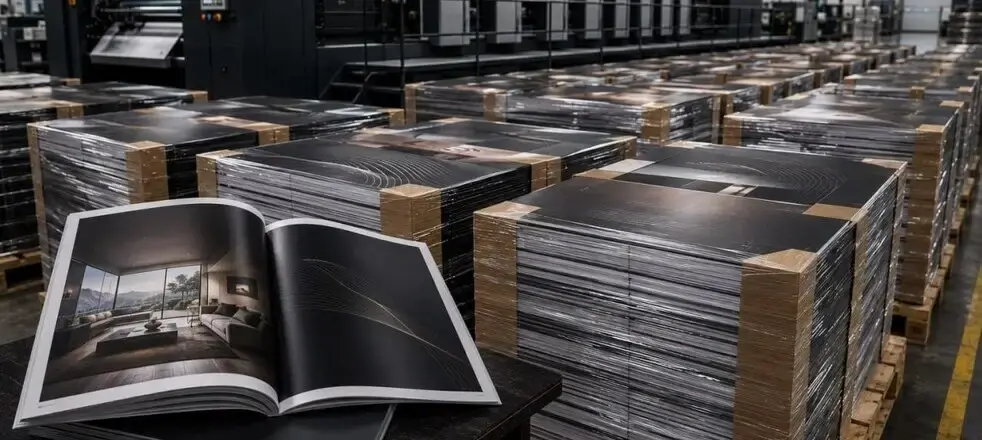
Offset Printing: Where It Actually Makes Sense in Business Projects
Key takeaways:
- offset printing is chosen for stability, not speed;
- it becomes financially viable only after setup costs are absorbed;
- best suited for repeatable production rather than one-off jobs;
- handles complex finishing and packaging workflows reliably;
- not practical for variable or frequently updated content.
How Offset Printing Functions in Real Production
Instead of focusing on theory, it’s more useful to understand what happens on the production floor.
In offset printing, the image is not applied directly to the paper — it is first transferred to a flexible surface and only then pressed onto the final material. This additional step reduces mechanical stress and evens out ink distribution. The result is not just “better quality” — it is predictable output across long runs, which is what production teams actually care about.
Why Businesses Still Choose Offset Printing
Predictability Over Speed
In many commercial projects, speed is not the primary constraint — consistency is.
Offset printing is preferred when:
- the same file needs to be reproduced thousands of times,
- there is no tolerance for colour shift, and
- reprints must match previous batches.
This is common in:
- brand rollouts,
- multi-location retail campaigns, and
- corporate documentation.
Cost Behaviour That Rewards Volume
Offset printing is structured differently from digital.
Before printing starts:
- plates are produced,
- machines are calibrated, and
- colour is balanced.
This initial stage is costly.
However, once the press is running:
- additional units require minimal incremental cost.
This creates a break-even point where offset becomes cheaper than digital.
Packaging Production Requirements
Packaging is rarely linear — it combines graphics, structure, and finishing.
Offset printing fits into this workflow because it:
- integrates easily with die-cutting,
- supports rigid substrates, and
- maintains detail on large surfaces.
Typical production includes:
- folding cartons,
- branded retail boxes, and
- product packaging with visual emphasis.
Finishing Processes Depend on Print Stability
Many premium effects are sensitive to how ink behaves on the surface.
Offset printing provides a controlled base for:
- foil applications,
- embossing depth consistency, and
- coating adhesion.
Unstable ink layers can ruin finishing — offset reduces that risk.
Offset vs Digital: A Practical Decision Approach
Rather than comparing features, it’s more useful to evaluate production scenarios.
Offset Printing Fits When:
- quantity is clearly defined,
- artwork remains unchanged,
- visual consistency is critical, and
- finishing is part of the project.
Digital Printing Fits When:
- content changes frequently,
- turnaround time is minimal,
- quantities are uncertain, and
- personalisation is required
This distinction prevents overpaying for the wrong technology.
Production Formats in Offset Printing
Sheet-Based Production
Used when:
- format flexibility is required,
- quality is prioritised over speed
Common outputs include:
- brochures,
- marketing materials, and
- corporate print assets
Roll-Based Production
Used when:
- volume is extremely high,
- speed is critical
Typical outputs include:
- magazines,
- large-scale catalogues
Material Behaviour in Offset Printing
One of the less discussed advantages of offset printing is how it handles different surfaces.
Paper Performance
Offset printing adapts well to:
- coated stocks for image-heavy layouts,
- uncoated papers for text-based materials, and
- textured surfaces where digital printing may struggle
Board and Packaging Substrates
It is also suitable for:
- folding cartons,
- kraft-based materials, and
- thicker packaging boards
This makes it relevant for both marketing and product packaging.
Where Offset Printing Becomes Inefficient
Despite its strengths, offset is not always the right decision.
Avoid using it when:
- quantities are low,
- deadlines are extremely tight, and/or
- content requires frequent updates
In such cases, the setup effort outweighs the benefits.
How Businesses Typically Make the Choice
In real projects, the decision is rarely about “which technology is better.”
It comes down to three questions:
- How many units are required?
- Will the design remain unchanged?
- Does the project include finishing or packaging elements?
If the answer aligns with stability and scale — offset printing is usually the correct choice.