Large Format Printing: How It Is Used in Retail Spaces and Events
Key Takeaways:
- Large format printing is used to control visual space, not just to display information.
- It is essential for temporary branding, exhibitions, and in-store communication.
- Material and installation method determine durability more than print itself.
- Production speed makes it suitable for time-sensitive campaigns.
- Design must consider viewing distance rather than close inspection.
What Large Format Printing Actually Involves
In commercial production, large format printing is not defined only by size. It refers to creating graphics that are integrated into physical environments rather than handled as standalone print items.
Unlike brochures or catalogues, these prints:
- interact with space
- influence movement and attention
- are often part of temporary installations
This changes how they are designed, printed, and installed.
Event Applications: Where Large Format Printing Is Critical
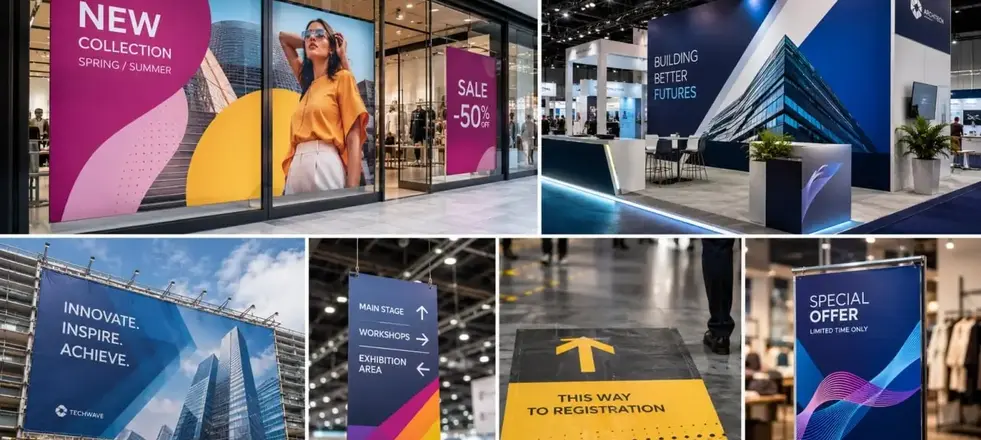
Spatial Branding for Exhibition Stands
At exhibitions, printed graphics are not decorative — they define how a brand is perceived within seconds.
Large format printing is used to:
- cover structural panels
- create visual boundaries
- highlight key messages without overcrowding
Production decisions often prioritise:
- ease of transport
- quick assembly
- consistent appearance under artificial lighting
Wayfinding and Crowd Direction
Events rely on clarity.
Printed navigation elements must:
- be readable from distance
- remain visible in crowded environments
- function without requiring detailed attention
Typical formats include:
- suspended banners
- freestanding directional boards
- floor-based indicators
Stage and Backdrop Systems
In conferences and corporate events, large format graphics are used to frame the main content.
These prints:
- appear on camera
- sit under strong lighting
- must avoid reflections and colour distortion
Materials are selected not only for print quality, but also for how they behave under stage conditions.
Outdoor Event Graphics
External installations introduce different technical requirements.
Printed materials must withstand:
- wind load
- prolonged sunlight
- repeated handling during setup
Solutions often include:
- perforated structures to reduce resistance
- reinforced edges
- weather-resistant inks
Retail Applications: Controlling Customer Attention
Storefront and Window Surfaces
Retail windows act as communication channels rather than just display areas.
Large format graphics are used to:
- block or filter visibility
- deliver campaign messages
- create seasonal identity
Depending on the objective, materials may:
- allow light through
- be removable without residue
- support full coverage
Interior Visual Zoning
Inside a store, large format printing helps organise space without structural changes.
It is used to:
- separate product categories visually
- guide customer flow
- emphasise promotional zones
Unlike small print, these elements work at peripheral vision level.
Promotional Surfaces and Sales Drivers
Retail environments constantly change.
Large format print is applied to:
- floors
- hanging elements
- end-of-aisle displays
These applications are temporary by design and must balance durability with easy replacement.
Short-Term Retail Installations
Pop-up stores and seasonal campaigns require fast deployment.
Large format printing supports:
- rapid branding of temporary locations
- lightweight structures
- adaptable visual systems
Production timelines are often measured in days, not weeks.
Materials: Why Selection Matters More Than Size
The performance of large format printing depends heavily on the choice of substrate.
Flexible Media
Used where mobility or temporary use is required:
- banner materials
- textile-based prints
- adhesive films
They are chosen for:
- ease of transport
- simple installation
- cost efficiency
Rigid Panels
Used where structure is required:
- foam-based boards
- plastic sheets
- composite materials
These provide:
- flat surfaces
- dimensional stability
- clean presentation
Functional Materials
Certain applications require specific properties:
- airflow (mesh structures)
- illumination (backlit films)
- slip resistance (floor graphics)
These are selected based on environment rather than design.
Printing Technologies and Their Roles
Different technologies are used depending on the application.
Eco-Solvent Systems
- suited for outdoor graphics
- resistant to environmental exposure
- commonly used for signage and banners
UV Printing
- allows direct printing on solid materials
- produces durable surfaces
- used for rigid signage
Latex Printing
- preferred for indoor environments
- low odour output
- suitable for enclosed spaces
Finishing and Installation: The Hidden Part of the Process
Large format printing does not end with printing.
Finishing Includes
- cutting to custom shapes
- reinforcement for mounting
- surface protection
Installation Considerations
- mounting surface compatibility
- duration of use
- environmental exposure
Incorrect installation can compromise even high-quality print output.
When Large Format Printing Is the Right Tool
Use it when:
- visibility across distance is required
- branding must dominate a physical space
- the environment changes frequently
- production time is limited
Limitations to Keep in Mind
- not suitable for detailed reading
- performance depends on conditions
- requires coordination between print and installation