Address Folders: Classification, Materials and Production Techniques
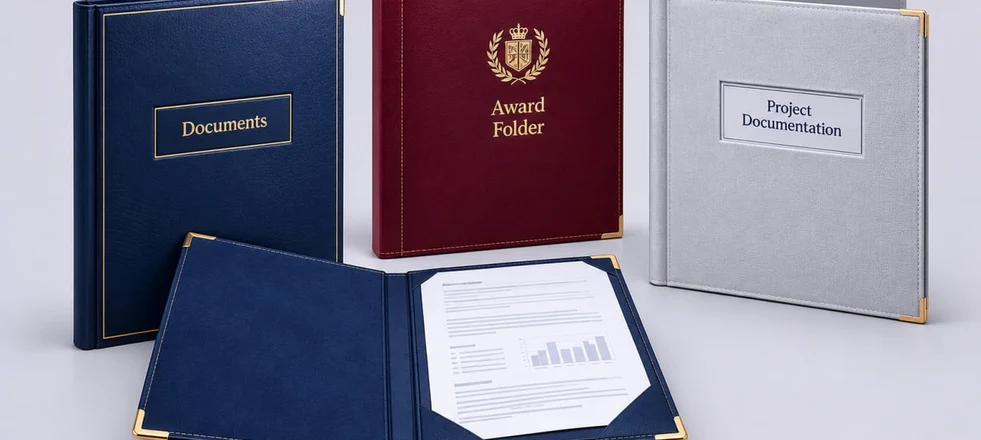
Address folders are specialised tools for organising document workflows. Their key structural difference from standard archive folders is the presence of a labelling window or space for identifying the contents, such as a project title, file number or address. This makes documents quicker to locate and easier to store in an organised manner.
Applications
Address folders serve a range of document management needs:
- Corporate sector: creating archives and storing project and tender documentation.
- Educational institutions and government: organising reports and teaching materials, storing diplomas and certificates of achievement.
- Event industry: supplying award items, folders for signing memorandums and presentation kits.
- Private use: storing family records and legal agreements for archival purposes.
Construction and Covering Materials
Address folders are custom-made to individual specifications. The folders are made from 1,750–2,000 g/m² binding board, which provides structural rigidity and protects the documents inside. The outer covering and inner lining are chosen to suit the intended use and quantity required:
- Vinyl paper offers a good balance between cost and wear resistance.
- Synthetic and textile materials feature distinctive textures and are suitable for premium presentation products.
- Genuine leather and velvet are used for presentation and award folders.
- Inner lining can be made from coated paper, velvet or flocking, depending on the budget.
Branding Techniques
Corporate logos and other branding elements can be applied to bookbinding materials using various finishing methods. The most suitable method depends on the type of material being used:
- Silkscreen printing is used to apply coloured graphics to bookbinding vinyl and synthetic materials.
- Blind embossing creates a raised design without ink, highlighting the texture of the material.
- Foil stamping is used to transfer metallic or pigmented foil onto the material, highlighting the logo.
Material Selection
The choice of covering material depends on the intended use and the project budget. Binding board is a standard option for day-to-day document management and archival storage of standard A4 document sets. It provides reliable protection against mechanical damage.
Microfluted corrugated board is a practical choice for folders designed to hold thick presentation packs. It offers greater strength and keeps bulky document sets neatly organised, making it a practical choice for offices that handle large volumes of paperwork.
Vinyl paper is ideal for folders that need to carry corporate branding. It is hard-wearing, has a leather-like texture and works well with screen printing.
Genuine leather and high-quality synthetic materials are used for award folders, diplomatic folders and presentation folders, where the look and feel of the material matter more than cost.
Careful selection of materials and post-press finishing techniques is essential to achieving the required technical specifications and quality standards.